Blog · Practical
Moving to a Senior Residence: Preparing the Transition and the First Days
Practical guide to supporting an older loved one through the transition from home to a senior residence: preparing the move, emotional aspects, adaptation, and tips for the first days.
Dignéa · March 14, 2026 · 9 min read
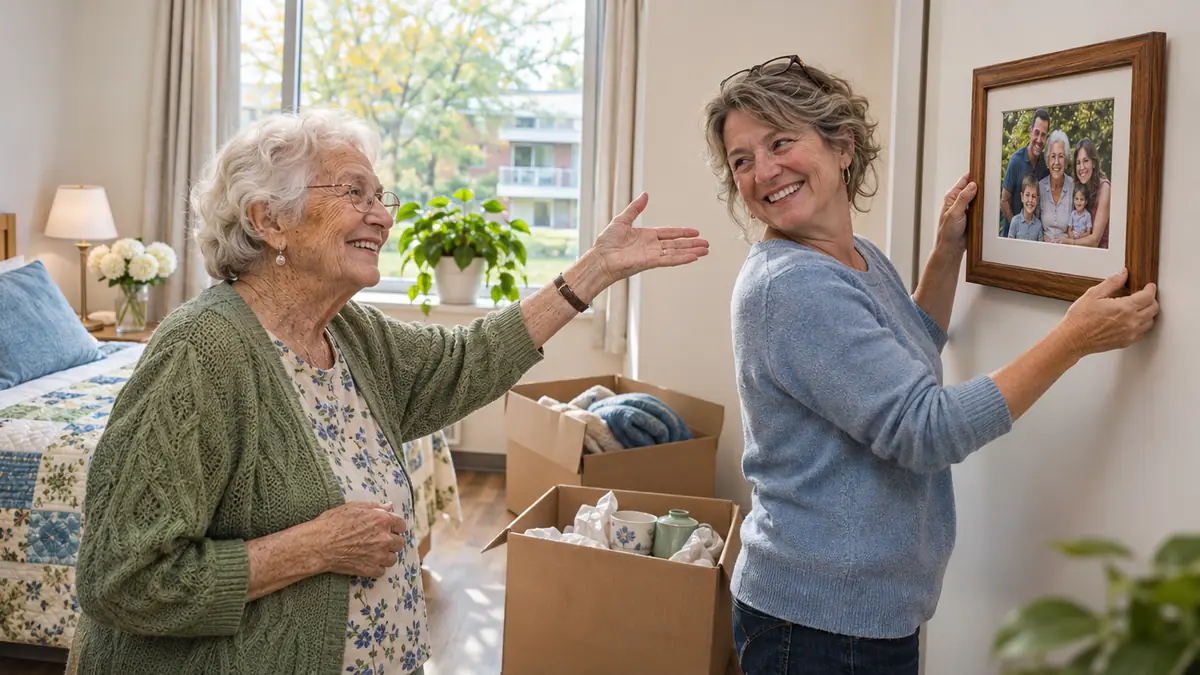
The decision has been made: your loved one is going to move into a senior residence. This step, even when well-prepared and desired by everyone, represents a major life change. For many older adults, leaving their home - the place where they may have lived for decades, raised their children, and anchored their identity - is one of the most difficult transitions of their lives.
This guide walks you through the practical and emotional steps of this passage, to make the first days in residence as positive as possible.
1. Understanding the Emotional Dimension of Moving
Before talking about boxes and moving trucks, it is essential to acknowledge what this change means on an emotional level.
What Your Loved One May Feel
For many older adults, this move evokes:
- A loss of independence: leaving one's home often means accepting that you can no longer manage alone
- Grief: the grief of one's house, routines, sometimes one's neighborhood and neighbors
- Fear: of the unknown, of losing one's identity, of not fitting into this new environment
- Resistance: some older adults will oppose it for a long time before accepting, even if it is the best decision
These emotions are normal and deserve to be heard, not minimized. Avoid phrases like "you'll see, you'll love it" or "it's for your own good" said too early in the process.
What Family Members May Feel
The family also goes through an emotional transition:
- Guilt (am I making the right decision?)
- Sadness (my relationship with my parent will change)
- Relief (and guilt about that relief)
- Anxiety about the quality of care to come
It is important for all family members to acknowledge these emotions with each other rather than ignoring them.
2. Preparing the Move: The Logistics
Good logistical preparation is essential to reduce stress on moving day.
About 2 Months Before the Move
- Notify services: family doctor, pharmacy, banks, governments (Canada Revenue Agency, Revenu Québec, Retraite Québec, Service Canada for Old Age Security), credit union or bank, subscriptions (newspapers, magazines, online services)1
- Visit the unit with your loved one to measure spaces and plan which furniture to bring
- Establish the list of items to bring: prioritize objects with emotional significance (photos, beloved blanket, meaningful keepsakes)
- Plan the furniture layout in advance so your loved one can visualize their new home
About 1 Month Before
- Organize the sale, donation, or storage of items that will not come along
- Complete a change of address (Canada Post, financial institutions, doctors, etc.)
- Contact the residence to confirm the moving date, access procedures, and which services will begin
- Prepare a "first days kit": medications, important documents, clothing for the first days, comfort items
Moving Day
- Prefer a weekday morning: residence staff are more available to welcome a new resident
- Limit the number of people present: too many people can be stressful
- Take the time to properly set up familiar objects before leaving
- Do not rush the farewells: stay long enough for your loved one to feel settled and comfortable
What to Bring First
Essentials:
- Up-to-date medication list (in duplicate: one for the residence, one for you)
- Recent prescriptions or renewals
- Health insurance card and, if applicable, the private insurer's card for prescription drugs2
- Important documents (birth certificate, will, protection mandate)
- Clothing for 5 to 7 days (label each item with the name)
For comfort and personalization:
- Framed photos of family and friends
- Familiar blanket or pillows
- Books, magazines, or other hobbies
- Radio, personal television if the unit does not have cable included
- Plants (check the residence's policy)
3. The First Days in the Residence
The first weeks are often the most difficult. Adaptation takes time, and it is normal for your loved one to express sadness, irritability, or even ask to go home.
The First Days: Feeling Out of Place
The first week is often marked by:
- A feeling of strangeness and disorientation
- Difficulty sleeping in a new environment
- Confusion about schedules and spaces
- Sadness or tears, often in the evening
What you can do:
- Visit often, but not so long that your departure becomes an ordeal each time
- Call regularly (phone or video call)
- Bring small surprises (their favorite foods, flowers from the garden)
- Communicate with staff to get feedback on how your loved one is adapting
The Following Weeks: New Reference Points
Progressively, your loved one begins to orient themselves in their new routines:
- They begin to recognize staff and other residents
- Meals at the same times create a sense of continuity
- First activities may be tentatively tried
What you can do:
- Encourage participation in activities (sometimes, accompanying them the first time helps)
- Ask the activities coordinator to introduce your loved one to residents who may share their interests
- Continue regular visits, but try to make them predictable (same day, same time if possible)
Over Time: Integration
For many residents, integration takes several weeks. They begin to have routines, relationships, and reference points.
If your loved one shows significant signs of depression or refuses any integration, do not wait: talk to their doctor, to the residence's nurse if there is one, or to the CLSC (local community services centre), and consider psychological support.3
4. Making the Room Feel Like Home
A personalized room is an important factor in well-being. Here is how to achieve it:
- Arrange furniture in a logical and familiar way (if possible, reproduce a layout similar to the old room)
- Hang photos at eye level from the bed or favorite armchair
- Bring the decorative objects with the most emotional significance
- Provide a good lamp for reading if your loved one has that habit
- Set up the telephone in an accessible location, with important numbers programmed
5. Maintaining Connections and Identity
A common mistake is thinking that moving into a residence marks a break with previous life. On the contrary, the best transitions are those where the person's identity and connections are preserved and even enriched.
To maintain connections:
- Organize regular visits involving different family members
- Encourage close friends to visit
- Facilitate video calls with distant loved ones
- Maintain certain traditions (family meals in the residence for birthdays, weekly outings if possible)
To preserve identity:
- Share your loved one's life story with the care team (who they were, their achievements, their passions)
- Encourage activities that matched their interests before the move (gardening, music, knitting, reading)
- Respect their lifestyle habits as much as possible (bedtime, food preferences)
6. When Adaptation Is Difficult: Signs to Watch For
Most people adapt gradually. But certain signs warrant particular attention:
- Persistent refusal to eat for several days
- Severe disorientation beyond the first few weeks
- Unusual aggression toward staff or other residents
- Constant crying or expression of severe distress that persists
- Total withdrawal from all social interaction
If you observe these signs, talk without delay to the residence's management (and to its nurse, if there is one), as well as to your loved one's doctor or the CLSC.3 A medical assessment and possibly mental health support may be warranted.
Conclusion
The transition to a senior residence is rarely easy. It is a major life change that requires time, patience, and a great deal of love from the entire family. But with good preparation, sustained presence during the first weeks, and a carefully chosen residence, many residents ultimately find in their new environment a quality of life that sometimes exceeds their expectations.
If you are still choosing a residence, our guide Visiting a Senior Residence: The Complete Checklist can help you prepare your visits, and our guide The lease in a seniors' residence: what it contains, what can be negotiated explains what your loved one's lease should contain before they move in.
Sources
Sources verified on November 15, 2026. Prepared with the help of artificial intelligence.
Notes
-
Revenu Québec, Change in Situation and Advance Payments (tax credit for home-support services for seniors). If your loved one receives advance payments of this credit, a move must be reported to Revenu Québec immediately, by phone. ↩
-
Régie de l'assurance maladie du Québec, Health insurance or prescription drug insurance: what's the difference?. Under the Public Prescription Drug Insurance Plan, you present your Health Insurance Card; with a private plan, you present your insurer's card. ↩
-
Regulation respecting the certification of private seniors' residences, CQLR, chapter S-4.2, r. 0.01, sections 1, 2, 17 and 18. The regulation does not require a physician assigned to the residence; nursing care is offered only in category 3 or 4 residences, and in category 1, supervision may be provided by a resident, a supervising lessee or a volunteer. ↩ ↩2