Blog · Comparison
Autonomous vs. Assisted Living: How to Choose the Right Level of Care in Quebec
Complete comparison of care levels in Quebec senior residences: autonomous, semi-autonomous, and assisted care. How to assess the right level and anticipate evolving needs.
Dignéa · March 14, 2026 · 8 min read
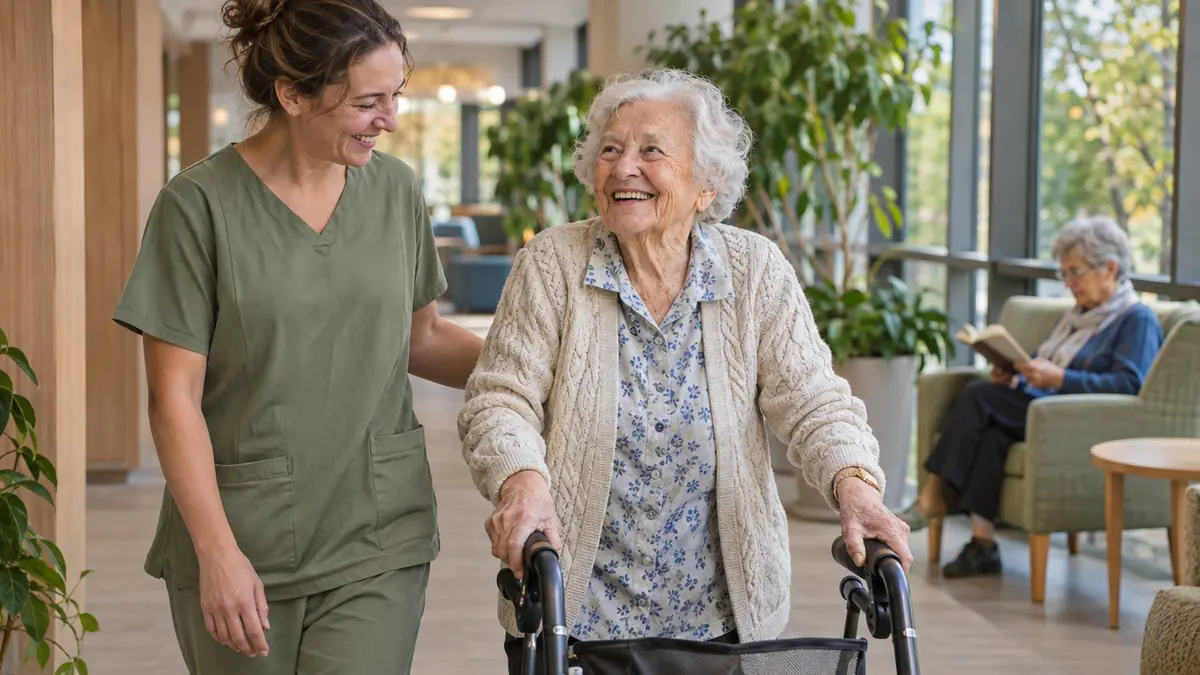
One of the first decisions when choosing a senior residence concerns the appropriate level of care. Choosing a level that is too low exposes the resident to safety risks and a premature move to another facility. Choosing a level that is too high leads to unnecessary costs and can even harm autonomy by limiting the person's freedom. This guide helps you see clearly.
1. The Main Care Levels in Quebec
The Regulation respecting the certification of private seniors' residences sorts private senior residences (RPAs) into four categories, which can be grouped into three levels of care: autonomous (categories 1 and 2), semi-autonomous (category 3), and moderate to severe loss of autonomy (category 4):
Level 1: Autonomous Living
The person is functionally independent for the essential activities of daily life. They do not need direct help to wash, dress, eat, or move around.
What the residence offers at this level:
- Housing (studio or apartment)
- Meals (1 to 3 per day depending on the package)
- Social activities and recreation
- Housekeeping services
- General building security
- Group transportation to shops or medical appointments
What the residence does NOT offer at this level:
- Assistance with personal care (bathing, dressing)
- Medication management assistance
- Regular nursing care
Typical profile: A 75-80 year old person in good health who wishes to benefit from a community and services, without the constraints of maintaining a house.
Level 2: Semi-Autonomous Living
The person needs partial assistance for certain activities of daily life, but retains significant autonomy in other areas.
What the residence offers additionally at this level:
- Help with hygiene (assisted bath or shower, help dressing)
- Medication management assistance
- Closer supervision
- Adapted meals if necessary
- Sometimes, a nurse or nursing assistant during the day (the regulation does not require it, so ask)1
Typical profile: A person with mobility problems (following a hip fracture, for example), who forgets their medications, or who is no longer safe for certain personal care tasks, but who remains oriented in time and space.
Level 3: Assisted Care (Long-Term Care Within an RPA)
The person needs substantial and constant help for most activities of daily life. They may have moderate to severe cognitive impairment, significant mobility problems, or regular medical needs.
What the residence offers at this level:
- Complete help with hygiene, dressing, and meals
- Medication distribution and supervision by qualified staff
- Nursing care included (category 4 of the registry); the law does not require a nurse on site at all times, so ask for the hours of presence1
- Specialized units (for cognitive impairment)
- Wound care, palliative care (in some residences)
- Adapted therapeutic activity program
Typical profile: A person with moderate Alzheimer's, advanced degenerative disease, or significant physical loss of autonomy (no longer walking, difficulty managing continence alone, etc.)
2. The Assessment Tool: The SMAF
In Quebec, the autonomy level of an older person is assessed in a standardized way using the Functional Autonomy Measurement System (SMAF). This tool evaluates 29 functions grouped into 5 categories:
| Category | What Is Assessed |
|---|---|
| Activities of daily living (ADL) | Eating, washing, dressing, personal care, grooming |
| Mobility | Moving indoors, outdoors, on stairs |
| Communication | Seeing, hearing, speaking |
| Mental functions | Memory, orientation, comprehension, judgment |
| Domestic activities (IADL) | Preparing meals, housekeeping, shopping, managing finances |
Each function is scored from 0 (autonomous) to -3 (dependent). The result places the person in one of 14 Iso-SMAF profiles: the higher the number, the greater the loss of autonomy. Profiles 10 to 14 are the ones for which CHSLD placement is generally considered. The profile is a benchmark: the housing decision rests on a full assessment and on the team's judgment.
Important: In the public network, a home support worker from the CLSC performs this assessment. With your written consent, a private residence may carry out a screening (the Prisma-7 tool) or an autonomy assessment (the SMAF, by an authorized professional), but it cannot use it to require a service that is not included in the rent, and this does not replace the network's assessment.2
3. Direct Comparison: Summary Table
| Criterion | Autonomous | Semi-Autonomous | Assisted Care |
|---|---|---|---|
| Help with personal care | No | Partial | Complete |
| Medication assistance | No | Reminders or partial | Complete |
| Nursing care | Consultation services possible | Depends on the residence | Included (category 4); ask for the hours of presence |
| Continuous supervision | No | Partial | Yes |
| Required mobility | Autonomous | Light assistance | Can be total |
| Expected cognition | Intact | Slightly affected | Can be severely affected |
| Monthly cost | Lowest | Higher | Highest |
| Freedom to go out | Total | Wide | Supervised |
4. How to Know Which Level Is Appropriate
Here is a series of practical questions to help you assess your loved one's current level:
Assessment of Basic Activities
- Can they bathe or shower alone without risk of falling?
- Do they dress independently, including buttons and zippers?
- Do they eat alone without direct assistance?
- Do they move around safely (alone, with a mobility aid, or do they need a person)?
- Do they manage their medications reliably?
Cognitive Assessment
- Are they oriented in time (date, time, season) and space?
- Do they have episodes of confusion, disorientation, or unusual behaviors?
- Do they manage their finances adequately?
- Do they make reasonable decisions for their own safety?
Safety Assessment at Home
- Have there already been falls at home?
- Have they left the gas on, forgotten to turn off the stove, or forgotten to lock the door?
- Do they show behaviors that put their safety at risk (nocturnal wandering, uncontrolled outings, elopement)?
If you answer "yes" to several questions in the last category, an urgent assessment by a health professional is necessary, and the required care level is probably semi-autonomous or assisted care.
5. Anticipating Evolving Needs
The choice of a care level is not permanent. Needs evolve over time, often gradually, sometimes suddenly (following hospitalization, a fall, a stroke).
Two main strategies exist:
Strategy 1: Choose a Residence With All Care Levels
Some residences offer all care levels under one roof. If your loved one's autonomy decreases, they can move to the next level without relocating. This is the ideal solution to avoid traumatic moves.
Advantage: Continuity of life, familiar staff, familiar environment. Disadvantage: These residences tend to be larger and sometimes more expensive.
Strategy 2: Enter at a Level Slightly Above Current Needs
If your loved one is "on the border" between autonomous and semi-autonomous, entering semi-autonomous directly can prevent a premature relocation.
Advantage: Prevention of a stressful short-term move. Disadvantage: Higher monthly cost immediately.
6. When a CHSLD Becomes the Right Option
When needs exceed what even an RPA with assisted care can offer, the CHSLD (Centre d'hébergement et de soins de longue durée) becomes the appropriate reference. This generally occurs when:
- The person needs heavy and continuous nursing care
- They can no longer walk and require specialized transfer equipment
- They have severe dementia-related behaviors requiring ultra-specialized supervision
- They require intensive end-of-life palliative care
The CHSLD placement request is made through the CLSC: a worker assesses the person with the Multi-clientele evaluation tool (OÉMC, Outil d'évaluation multiclientèle), then the file follows the housing access mechanism, according to priority.
Conclusion
Choosing the right level of care is perhaps the most important decision in the residence selection process. An honest and professional assessment of current needs - and a reflection on their likely evolution - helps avoid premature moves and crises. Do not hesitate to request a formal assessment by the CLSC if you are unsure of the appropriate level.
When you call or visit, ask each residence for its certification category and the services included in the rent: it is the simplest way to check that it matches your loved one's level of care.
Sources
Sources verified on November 15, 2026. Prepared with the help of artificial intelligence.
Notes
-
Regulation respecting the certification of private seniors' residences, CQLR, chapter S-4.2, r. 0.01, section 1 (categories 3 and 4) and sections 19 and 20 (care staff), LégisQuébec. ↩ ↩2
-
Regulation respecting the certification of private seniors' residences, CQLR, chapter S-4.2, r. 0.01, section 13.1 (identification and assessment tools), LégisQuébec. ↩